


- Home
- Water Care
- Nitrate remover
- Plant aquarium nitrate remover
Plant aquarium nitrate remover
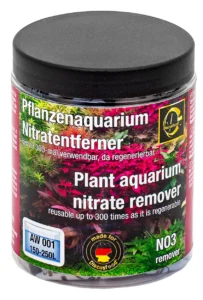 Plant Nitrate Remover – Targeted Nitrate Control for Planted Aquariums
Easier than ever: targeted nitrate control for a balanced planted aquarium.
Nitrate (NO₃⁻) is produced in aquariums primarily through the biological breakdown of nitrogen-containing waste and uneaten food. In the biological nitrogen cycle, ammonium is converted into nitrite and then into nitrate. Nitrate is an important plant nutrient, but it can accumulate in closed aquarium systems. The key is therefore not to remove nitrate completely, but to adjust its concentration to the actual needs of the aquarium.
The Discusfood Solution
The new Discusfood Plant Nitrate Remover AW 001, AW 002 and AW 003 product range has been developed for targeted control of nitrate levels in planted aquariums.
The system helps aquarists reduce excessive nitrate concentrations while taking into account the specific requirements of planted aquariums. Aquatic plants need nitrate as a nitrogen source for growth. Maintaining nitrate levels according to the aquarium’s needs helps achieve a balanced relationship between nutrient availability, plant growth and water quality.
How Does Nitrate Removal Work?
Targeted nitrate removal can be achieved through ion exchange. During this process, nitrate ions are bound to a suitable exchange material and exchanged for other ions. Actual performance depends on factors including the material used, water composition and the initial nitrate concentration.
An important advantage of regenerable ion-exchange materials is that they can be regenerated and reused under suitable conditions once their capacity has been exhausted. The fundamental mechanisms of nitrate removal and regeneration are described in scientific literature.
For a Balanced Aquarium
A planted aquarium requires a carefully balanced nutrient supply. If nitrate levels are reduced too much, plant growth may be affected. Regular monitoring of nitrate levels is therefore recommended, along with adjustments to the application based on fish stocking levels, feeding, plant biomass and lighting.
When used correctly and under controlled conditions, nitrate regulation can be a valuable part of aquarium water care. However, compatibility with fish and shrimp also depends on correct application, water composition and compliance with the product-specific instructions for use.
Discusfood AW 001–AW 003: For a controlled nitrate supply and aquarium water care tailored to the needs of planted aquariums.
1. Application in the Aquarium
- Select the appropriate model: Choose the suitable AW Nitrate Remover according to the aquarium size and intended application.
- Install the filter material: Place the filter material in the filter according to the product-specific instructions.
- Ensure proper water flow: Make sure the filter material receives adequate water flow for even water treatment.
- Monitor water parameters: Regularly measure nitrate levels before and during application using a suitable water test.
- Adjust the application: Adapt nitrate regulation to the needs of aquatic plants and the desired nitrate range. Nitrate should not be completely removed without proper monitoring.
2. Regeneration with Non-Iodized Table Salt
Required materials: Non-iodized table salt and clean water.
- Prepare the salt solution: Completely dissolve 100 g of non-iodized table salt in 1 litre of water.
- Immerse the filter material: Fully submerge the AW Nitrate Remover in the prepared salt solution.
- Move gently: Gently move the material in the solution to ensure that the salt solution reaches all areas.
- Rinse thoroughly: After the specified soaking time, rinse the regenerated material thoroughly with suitable water to remove any remaining salt solution.
- Reinstall: Only return the filter material to the aquarium after thorough rinsing and in accordance with the product-specific instructions for use.
Important notes: Do not use iodized salt. The used regeneration solution contains released substances, including nitrate, and must never enter the aquarium. Always carry out regeneration outside the aquarium.
Further information: Detailed instructions for application and regeneration can be found in the package insert.
Package Insert / Instructions
Not for human consumption! STORE IN A COOL, DRY PLACE!
Article No.:
AW 001 – 150–250 L
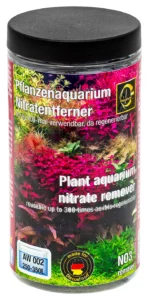
Article No.:
AW 002 – 250–350 L
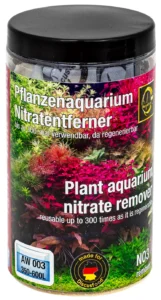
Article No.:
AW 003 – 350–600 L